


Let’s pretend you’re running twenty minutes late to meet friends and you’re feeling awful about it. What do you do? If you’re a responsible human, you’ll call or send a message to apologise and to communicate your best estimate (bestimate, if you fancy) for how late you’re running. If this is your approach as a latecomer, I’ll call you realistically late. To run realistically late is common, and, if you are such a person, any other course of action might seem utterly inconceivable. But some of us don’t run realistically late. Some of us run hopefully late.
To run hopefully late means telling our friends we’re running ten minutes behind when the reality is closer to twenty. Maybe we haven’t truly considered the situation in detail and it’s just a lazy guess, an estimate with a shrug. Or maybe it’s a conscious or unconscious desire to underplay how late we’re running to those affected, to minimise how much of a big deal it is. We don’t want to make the bad situation worse, or admit to our own failings, and so we soften the reality as best we can. Nobody panic, we say. Everything’s fine.
These are the two most common models for running behind, but I’d like to propose a third. I’d like to propose that the next time you’re running behind, you see how it feels to be pessimistically late, and to say you’re running later than you think you are. It will probably feel unnatural at first to paint an even gloomier picture than you suspect is true, but here are three reasons why you should.
1. The Intangibles
The most sensible reason to say you’re running later than you think you are is that you probably are running later than you think you are. And that’s because of one very simple fact: the consequences of whatever caused your delay have yet to fully play out. This is even true if the only reason for your lateness is your own poor time management.
You don’t yet know that you can’t find your keys because you won’t know they’re missing until you look for them. You don’t truly know how bad traffic is until you’re out the other side (regardless of what your maps app tells you), ditto disruption on public transport (regardless of what the departure boards say). And, because you’ve yet to engage with it, you don’t yet know that the final part of the project you’re working on has a level of complexity you’ll need additional time to unpack, or, as the Ninety-Ninety rule from the world of computer programming states:
The first 90 percent of the code accounts for the first 90 percent of the development time. The remaining 10 percent of the code accounts for the other 90 percent of the development time.
(For what it’s worth, that’s why I suspect there’ll be one more delay on the GTA6 release date. It’s a project of such complexity that it’s impossible to predict how long it will take to complete, even for those who are making it.)
These are the intangibles of running behind. You don’t know yet what you don’t yet know, and so you are later than you think you are.
2. The Rise and Fall of Resentment Levels
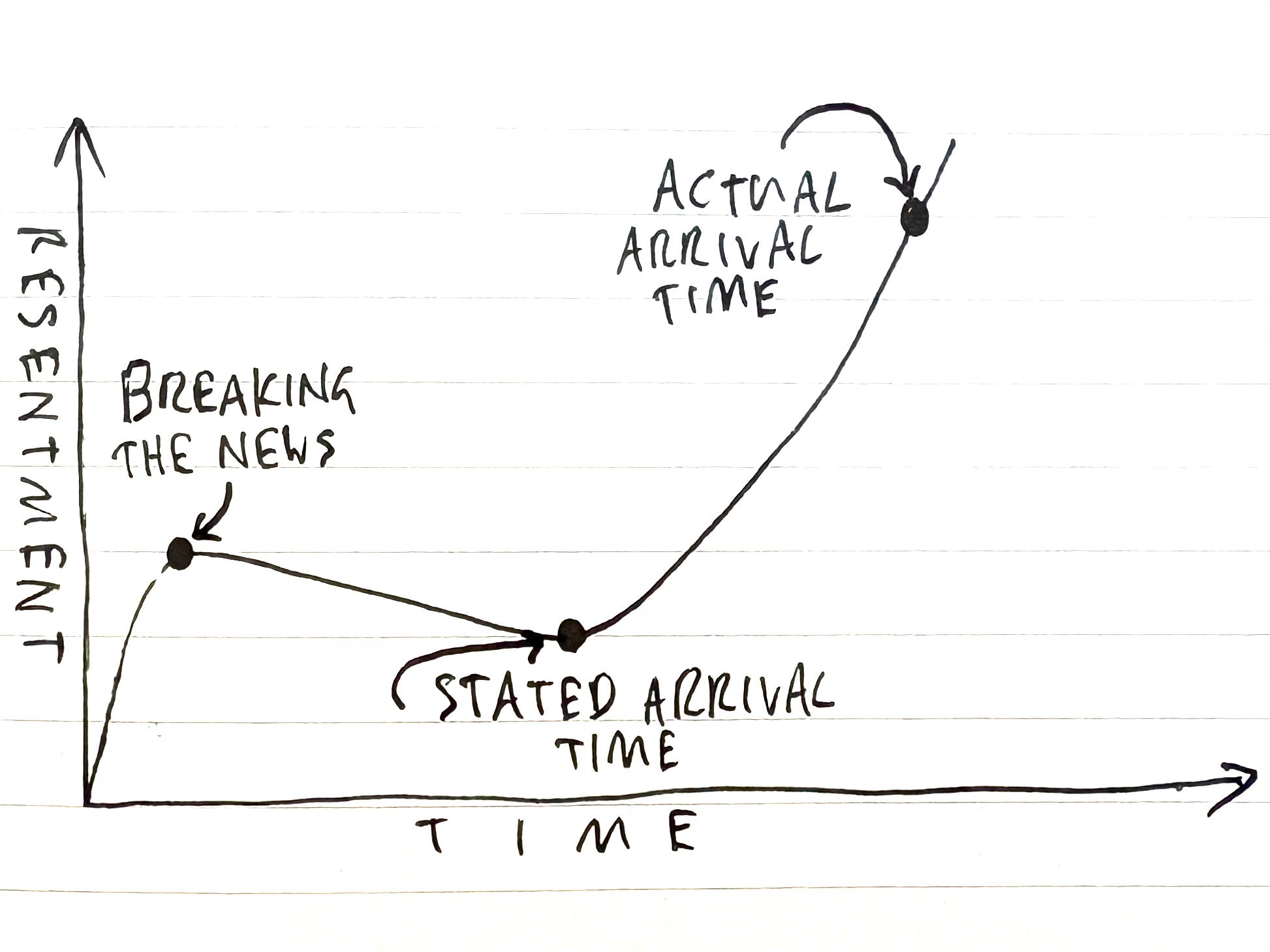
Let’s imagine you’re running hopefully late, so you tell your friends you’re running ten minutes behind rather than twenty. You’ve made yourself feel better (for a moment) and you’ve somewhat appeased your friends (for now). The situation is far more palatable. Well done.
But you’ve made a terrible mistake. You haven’t changed the reality of the situation. You’ve only changed the moment at which your friends learn the truth. They may be less annoyed when you initially break the news, but they’ll now be waiting longer than you told them they’d have to, so they’ll be more annoyed by the time you get there. The ten minutes you omitted now becomes time in which any negative feelings can crescendo, building to a climax just in time for your actual arrival.
Now let’s rewind and imagine you tell your friends you’re running thirty minutes late instead. Thirty minutes‽ Your friends are upset – that’s pretty late. You create peak resentment at the moment you break the news, but – because you’ve yet to arrive – you’re not around to experience it (thank goodness you’re running late!). They now have a while to process what you’ve told them and come to terms with the situation, during which time resentment levels will likely descend.
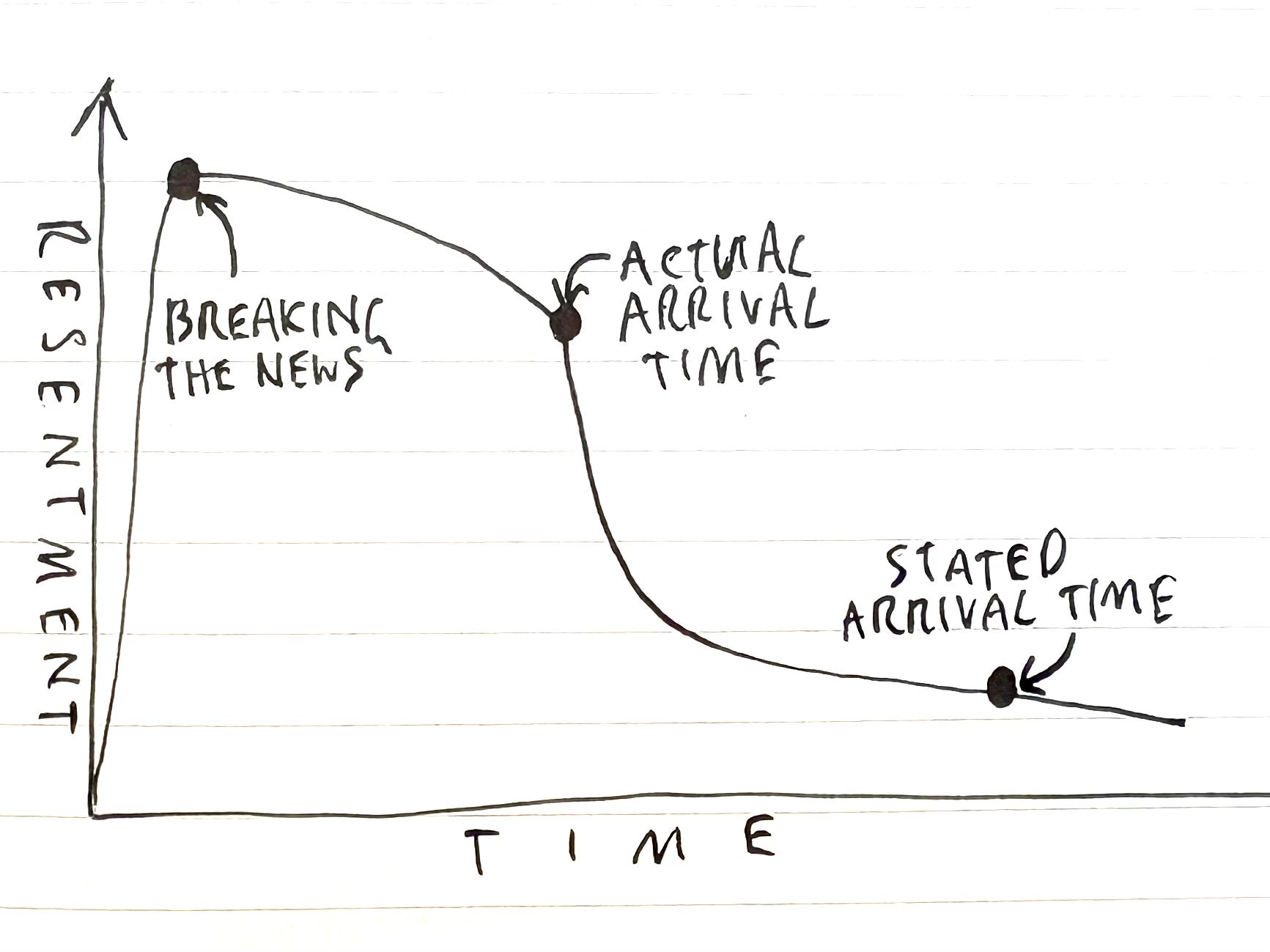
And when you do arrive, it’s not even as bad as everyone thought – you’re only twenty minutes late. Your friends are glad to see you.
3. You Can Now Be Early
You can now be early. Well, sort of. Obviously you’re still late – you’ve missed the agreed arrival time – but you’ve created the possibility of arriving early for the revised arrival time, the one that you dictated.
That’s an important detail, by the way. It’s the latecomer who dictates the revised arrival time. It’s an opportunity to regain control of the situation and it should not be treated lightly. If you get the revised arrival time wrong, then not only are you late for the agreed time, but you’re late for the new time too. You’re late twice. You’re a double-schmuck. Nobody wants to be a double-schmuck.
So there we are. Three observations on the possible merits of being pessimistically late. How much later should you claim to be running? Well, it will depend on the situation. I think adding 50% is about right for a small delay – if you think you’re running ten minutes late, call it fifteen. Maybe you’ll want to add a little less, especially if you have good experience of whatever has caused the delay. Maybe you should even add more if you’re working on a task you know is complex.
But beware! To employ this technique means running early for the revised time, and running early brings a kind of tranquility. If you were genuinely running early, you’d have earned this tranquility and you could enjoy it, but for our purposes it’s a trap. The point of being pessimistic about your arrival time is not so you can stop and grab a coffee on the way to the meeting, or so you can finally relax about that looming deadline. For the practice to be effective, you must do everything in your power to sustain your pace, otherwise you’re only recreating a new version of the same problem you sought to avoid, and you run the risk of being stuck in an endless loop of lateness – like one of Zeno’s paradoxes – perpetually in transit, trapped between the place you left and the place you’re going, distracted by the future, anxious about the journey, until you finally realise that the event came and went without you, and so you return home – departed but never arrived, alive yet not quite living.
Don’t do that, for goodness’ sake. Do anything but that.