


I’m secretly avoiding an enormous pile of laundry. It’s clean and dry, no problems there, but now it needs sorting and putting away. It sits on the same bed I dumped it on an hour ago and it cuts an intimidating figure – three feet high and four feet wide – impressive in its way, but also a reminder that I really need to do the laundry more often. It’s not going anywhere, this laundry pile. It is unapologetic and stubborn, and sooner or later I have to do something about it. I have to begin.
To begin. What a concept. The ultimate prerequisite. You can’t do anything without beginning it first – it’s literally impossible. You cannot continue what you haven’t begun, and you’ve no hope at all of completing it. But beginnings are sly and tricksy things, and the more we know we need to start, the more the start eludes us.
This is traditionally the domain of productivity gurus, of which I am very much not. Instead, I am awful and not someone anyone should seek to emulate. I have been fortunate enough to earn a living as a freelance writer for much of my life, and have spent most of my career gleefully committing to starting later and then being surprised when later arrives and I don’t have enough time. And it’s not like this only happened once. It happens as a matter of course. Time repeatedly demonstrates the manner in which it operates, how it’s passing by all the while – right this very moment, in fact – and that it won’t magically slow down for me later so I can catch up on what I missed. Meanwhile, I presume there’s loads of time – I don’t have that much to do – and it’ll all be fine I’m sure. Well, it’s never fine. There’s never enough time and I never learn. The repeated nature of this experience has led me to a tragic and inescapable conclusion: I am an idiot. The only upside of my idiocy is that I’m deeply intrigued by it, and so I enjoy spending time reading about and reflecting on the best ways of dealing with it.
One school of thought, popularised by Brian Tracy in the early 2000s, argues for the benefits of eating a frog. Many frogs are real (just ask a biologist), but this one is a metaphor – it’s your most difficult or important task – and eating it means doing it first and getting it done. The idea stems from an unverified Mark Twain quote: ‘Eat a live frog first thing in the morning, and nothing worse will happen to you the rest of the day.’ You’re familiar, I’m sure.
It’s a call to action, a slap round the face: come on, ya bastard – do the thing! Does this approach have merit? Maybe. To accomplish something early in the day is a much more pleasant feeling than spending the morning with the weight of that same task hanging over us. But for me, this frog-eating business has always felt like less of a call to action and more of a barrier to one. I'm not sure it’s helpful to focus our attention on what’s most difficult, and I’m not convinced that doing it first is conducive to the act of beginning. Some people may find a benefit in dramatising the start of something – to ‘attack’ the task, or to ‘crush’ the to-do list – but for me such language is less an incentive and more a deterrent.
The truth is – and I’ve found this to be a tremendously liberating thought – you can start wherever you want. The Start Police will not come for you if you fail to begin with something daunting. No task will be later appraised on how well its difficulty levels diminished throughout, nor how radically it began. And maybe the opposite is true. Maybe the best beginnings aren’t exerting too much effort or trying to prove a point. Maybe the best beginnings are small and quiet and mind their own business.
The world of psychology knows well that beginning a task creates tension, while completing it brings relief. Humans generally don’t like leaving things unresolved, which makes us more likely to return to tasks we have already begun. It’s bad news for workaholics who struggle to switch off over the weekend, but good news for freelance procrastinators who exist in a state of perpetual self-loathing, because we can use this information to help us. Consider this: we are more likely to continue than we were to begin. Or, to put it another way, once you’re already hoovering, it takes far less effort to keep going than it took to pick up the vacuum cleaner in the first place.
So! What is the easiest way to begin? It’s a question I return to as often as I can. It’s a hoax for myself, a game I play, a way of tricking the part of me prone to lethargy. The thought of finding the easiest task misdirects from the broader notion of actually beginning. I may not want to do the task, but I can at least search my inbox for the relevant email, or open a document and read the first sentence. I can even trick myself further by making the question hypothetical: ‘If I were going to start, where would I begin?’ I’m not actually going to start the thing (a preposterous notion) but if I were going to, what would I do?
The task is complex. To begin the task is simple. Both of these statements can be true at the same time.
And if you need an example of that, check out the work of the artist Reuben Margolin. He makes beautiful kinetic sculptures of wave forms, simple in their concept but astonishing in their complexity. One such sculpture, Contours, consists of 70,000 parts and took five intensive months of planning, machining and assembling to complete.
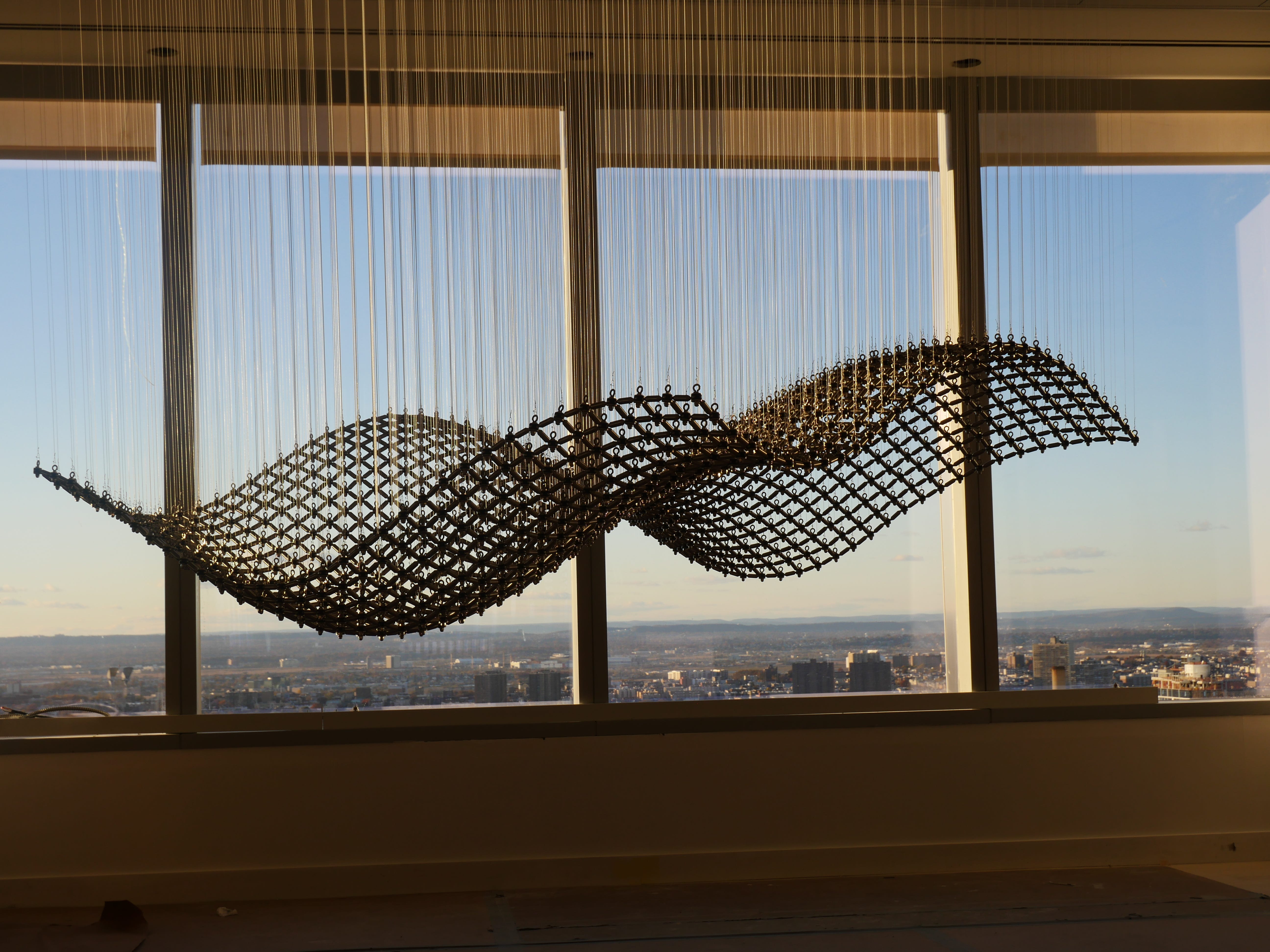
In 2021, I got to interview Reuben for Tangram magazine. I asked him about his process and how a new project comes to life. ‘Eventually things come together,’ he said, ‘and I take the first step, drilling a hole or cutting something. I usually think, well I’ll just make this one little part.’
Considering the precision and scale of a typical Reuben Margolin sculpture, there’s a huge disconnect between the finished state of the sculpture and the place he begins work on it – drilling a hole, or cutting something, or making ‘one little part.’ When I pointed this out to him he shrugged the question away. ‘You gotta start somewhere,’ he said. To him, and to all who don’t struggle with procrastination, maybe this statement is trivial – but the rest of us can learn from it. A beginning needn't be formal or grand. Reuben didn’t order all 70,000 parts to begin Contours.
That's significant, I think – the informality of the start. ‘Maybe there’s some material sitting around my shop,’ Reuben said, ‘and I’ll wonder whether maybe I could use that material for this particular part.’ Note how low he makes the barrier to entry, how little friction he creates. He’s not fussy about how he starts something. He begins with whatever’s nearby. Contrast that with the following.
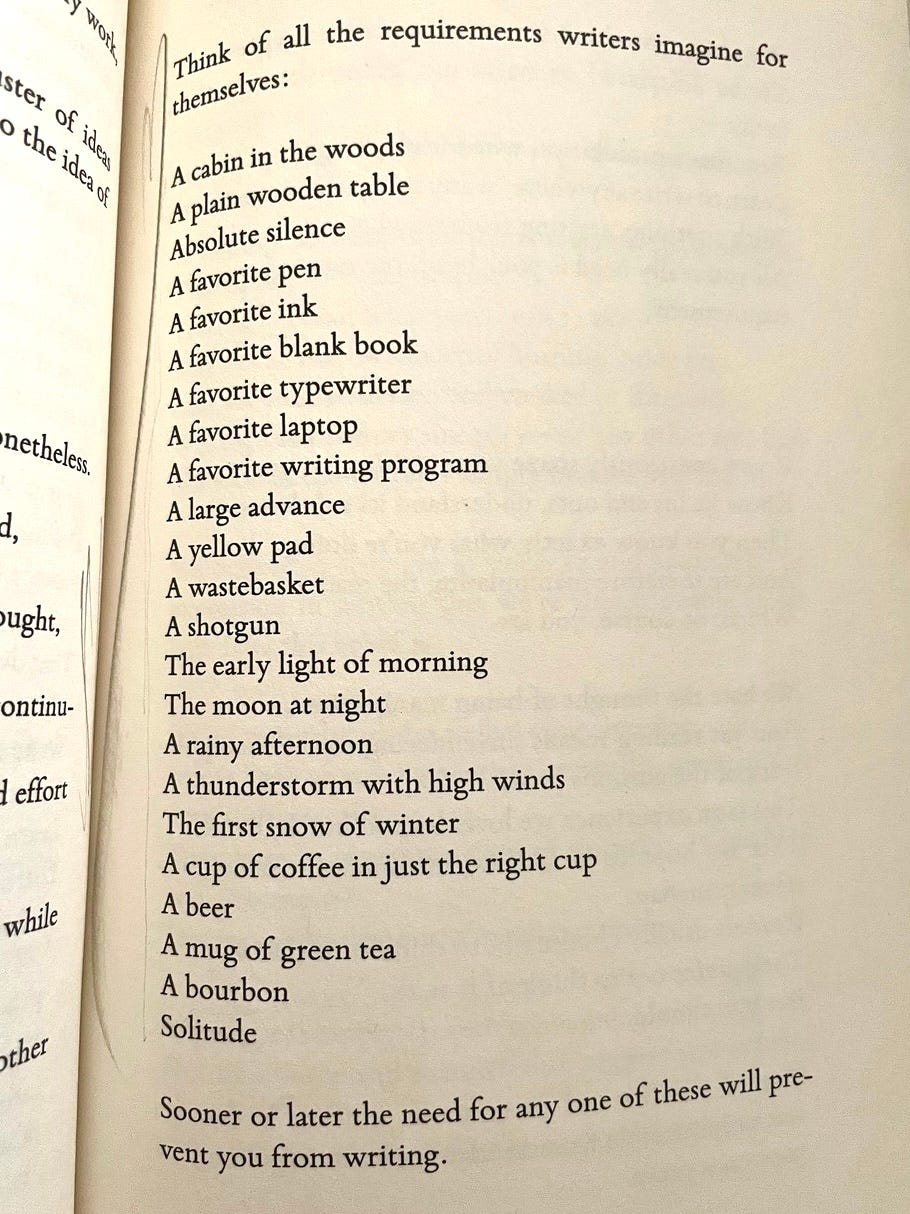
The first time I read this, I felt personally attacked. Not that I need a cabin in the woods or the first snow of winter – maybe I’m on the lower end of the scale – but there’s no doubt Verlyn Klinkenborg is writing about me. Sure, I’ll start writing, but I can’t possibly do that without a cup of tea – which means finding my favourite mug (the header image to this essay), or a clean desk – which means tidying it – and all the while the day slips away.
The more complex our idea of the beginning, the more barriers we create to entry, the less likely we are to begin. But the simpler our idea of it, the simpler we make our starting point, the simpler it becomes. Beginnings are not complicated. We are.
I glance again at my mountain of laundry. There, among the jumbled mound of hoodies and towels and pants, I see two yellow socks – one atop the pile, the other peeking out from within. The mountain is colossal and the job will take a while, but if nothing else I can pair the yellow socks. I can take out one and then the other. That doesn’t seem so hard.